
Every skilled musician shares one essential ability: the capacity to hear music internally before it is played. This skill, often called inner hearing, allows performers, composers, and improvisers to anticipate sound, recognize patterns, and respond musically with confidence. Ear training is the systematic development of this ability. It bridges the gap between theory and performance, transforming abstract knowledge into intuitive understanding.
Developing a strong musical ear is not limited to identifying notes correctly. It is about understanding relationships, predicting movement, and recognizing emotional nuance in sound. With consistent practice and thoughtful strategies, any musician can strengthen their inner hearing.
What Is Inner Hearing
Inner hearing refers to the ability to imagine and internally “hear” music without external sound. It allows musicians to read notation and mentally hear it, anticipate chord changes before they happen, and improvise with intention rather than guesswork.
When inner hearing is well developed, the connection between ear, mind, and instrument becomes seamless. Instead of searching for notes physically, musicians respond to what they already hear internally.
This skill enhances sight-reading, improvisation, composition, and ensemble performance.
The Importance of Interval Recognition
Intervals are the building blocks of melody and harmony. Recognizing the distance between two notes is one of the first steps in ear training.
Practicing interval recognition involves listening to two notes and identifying their relationship. Start with simple intervals such as seconds, thirds, and fifths before progressing to more complex ones.
Singing intervals strengthens retention. When musicians can sing an interval accurately, they internalize its sound more deeply than through passive listening alone.
Associating intervals with familiar melodies can also reinforce memory. Over time, the sound of each interval becomes instantly recognizable.
Scale and Tonal Awareness
Understanding scales is essential for developing tonal awareness. When musicians hear a melody, they should be able to sense its position within a key.
Practice singing major and minor scales slowly, focusing on how each degree feels relative to the tonic. Notice how certain notes create tension and how others provide resolution.
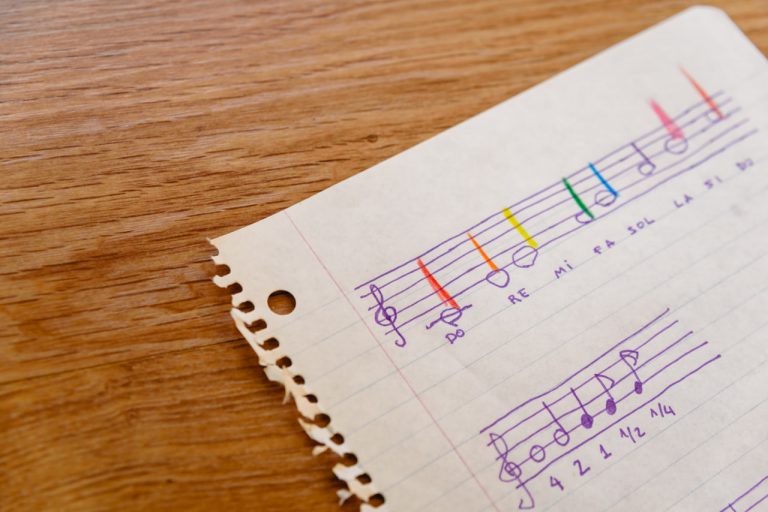
Solfege systems can be helpful for reinforcing scale relationships. Assigning syllables to scale degrees builds a consistent internal reference system.
The goal is not only to identify individual notes but to understand how they function within a tonal center.
Chord Identification and Harmonic Listening
Harmony plays a major role in shaping musical emotion. Ear training should include recognizing chord qualities and progressions.
Begin by distinguishing between major and minor chords. Then move to identifying dominant seventh, diminished, and augmented chords.
Listening to chord progressions and predicting their resolution strengthens harmonic awareness. Try pausing a recording before a cadence and anticipating the next chord internally.
This practice develops intuition and prepares musicians for improvisation and composition.
Rhythmic Dictation and Timing
Ear training is not limited to pitch. Rhythmic accuracy is equally important.
Clap or tap rhythmic patterns after hearing them once. Start with simple quarter and eighth note patterns, gradually introducing syncopation and complex subdivisions.
Counting aloud reinforces internal timing. The more accurately a musician can reproduce rhythm from memory, the stronger their overall musical coordination becomes.
Recording yourself and comparing it to the original pattern helps refine precision.
Transcription as Advanced Practice
Transcription is one of the most effective ear training tools. It involves listening to a piece of music and writing it down or learning it by ear.
Start with short melodic phrases. Slow the recording if necessary and repeat sections until the notes are clear. Over time, increase the length and complexity of passages.
Transcription sharpens listening skills, deepens stylistic understanding, and connects theoretical knowledge with real musical examples.
This process encourages active engagement rather than passive listening.
Singing as the Central Tool
Singing is perhaps the most powerful ear training strategy. Even instrumentalists benefit greatly from vocal practice.
When musicians sing phrases before playing them, they strengthen the connection between internal hearing and physical execution.
Sing scales, arpeggios, and simple melodies daily. Gradually introduce more complex patterns.
The voice forces accuracy. If you cannot sing it, you likely do not fully hear it internally.
Active Listening Techniques
Ear training extends beyond structured exercises. Active listening transforms everyday music experiences into learning opportunities.
When listening to a song, focus on one element at a time. Identify the bass line, the chord progression, or the melody’s contour.
Ask questions while listening. What key is this in? Where does the phrase resolve? Are there modulations?
The more attentively you listen, the sharper your musical perception becomes.
Using Technology Wisely
Modern tools can support ear training. Apps and software provide exercises for interval recognition, chord identification, and melodic dictation.
However, technology should supplement, not replace, active musical engagement. Singing, playing, and listening intentionally remain essential.
Use digital tools as structured practice sessions, but always connect exercises back to real music.
Developing Relative Pitch
Relative pitch is the ability to identify notes based on their relationship to a reference tone. It is far more practical for most musicians than perfect pitch.
To strengthen relative pitch, consistently reference the tonic of a key before identifying intervals or melodies. Over time, your ear becomes more sensitive to tonal relationships.
Practice identifying the scale degree of notes within a melody. This deepens understanding of musical function rather than isolated sound.
Integrating Ear Training into Daily Practice
Ear training should not be separated from instrumental practice. Integrate it into warm-ups and repertoire work.
Before playing a new piece, try to sing parts of it. When learning a chord progression, identify each chord quality by ear.
In improvisation practice, aim to play what you hear internally rather than relying solely on muscle memory.
Consistency matters more than duration. Short, focused daily sessions are more effective than occasional long ones.
Overcoming Common Challenges
Many musicians feel frustrated when ear training seems difficult. Progress can feel slow at first.
Patience is essential. The ear develops gradually, just like technical skills on an instrument.
Avoid comparing yourself to others. Focus on incremental improvement and celebrate small milestones.
Regular repetition builds familiarity, and familiarity builds confidence.