
Rhythm is the lifeblood of music. It provides motion for melody, form for harmony, and pulse for the performer. Without rhythm, music would be lacking in character and vitality. As harmony controls the color of music and melody supplies its detail, so rhythm gives order to sound through time. To play with conviction, write with clarity, and perform with authority, each musician must possess a fundamental feeling for rhythm and meter.
Rhythm develops musical skills, physical coordination, timing, and expression for both the musician and the audience.
Rhythm is the pattern or placement of sounds in time. When you know rhythm, you know how to tell when to play or sing and for how long.
Rhythm – The organisation of sounds and silences in time. It tells you when notes should be played, how long they should be played for and how they should interact with one another.
Every piece of music has a rhythm. There are rhythms that sound predictable and repetitive and rhythms that are more surprising and intricate. Even the simplest rhythmic motif can evoke a mood from a melody or harmony.
Rhythm is ultimately a matter of time and space. It’s an issue of how notes subdivide the pulse, and what relationship those subdivisions have to the pulse itself.
The Pulse and the Beat
Pulse refers to the underlying, constant rhythm that you would instinctively tap your foot to. It’s the fundamental measurement of time.
Beat is used to measure equal amounts of time. A note may be worth a beat, multiple beats, or a part of a beat. Keeping a steady beat is one of the first skills a musician should acquire.
A steady pulse gives the music a sense of foundation. Unintended changes in the pulse can make the music seem uncertain. Having control of the pulse results in a clear and secure musical performance.
A meter is a device that measures how much of a particular quantity — such as electricity, gas, or water — is being used by a home or business. It does this by tracking the flow of the commodity into the home or business and calculating how much is being consumed.
We know that beats are used to organize sounds into groups. In particular, beats are grouped together in a measure. The number of beats in a measure is determined by the time signature of the piece. The time signature also tells us what kind of note will be used for a beat.
The most common meters are 4/4, 3/4, and 2/4. Each of these gives a different feel to the music. 4/4 is the rhythmic feel most often heard in music, and has a strong down beat, 3/4 is the waltz rhythm and 2/4 is the feel of a polka.
A working knowledge of meter allows a performer to expect which beats are likely to be accented and which are not, which in turn influences musical phrasing.
STRONG and WEAK beats
Not all beats are created equal. In any meter, some beats will have more of a pulse than others.
4/4 time — Beat 1 is usually the most accented beat, then beat 3 is the next strongest, and so on. Natural accents help determine phrasing.
The ability to feel the strong and weak beats in music gives a musician a lot of information about how to perform a rhythm with good interpretation. Articulation, dynamics, and general feeling are all affected by the knowledge of these strong and weak beats.
Accuracy and Granularity
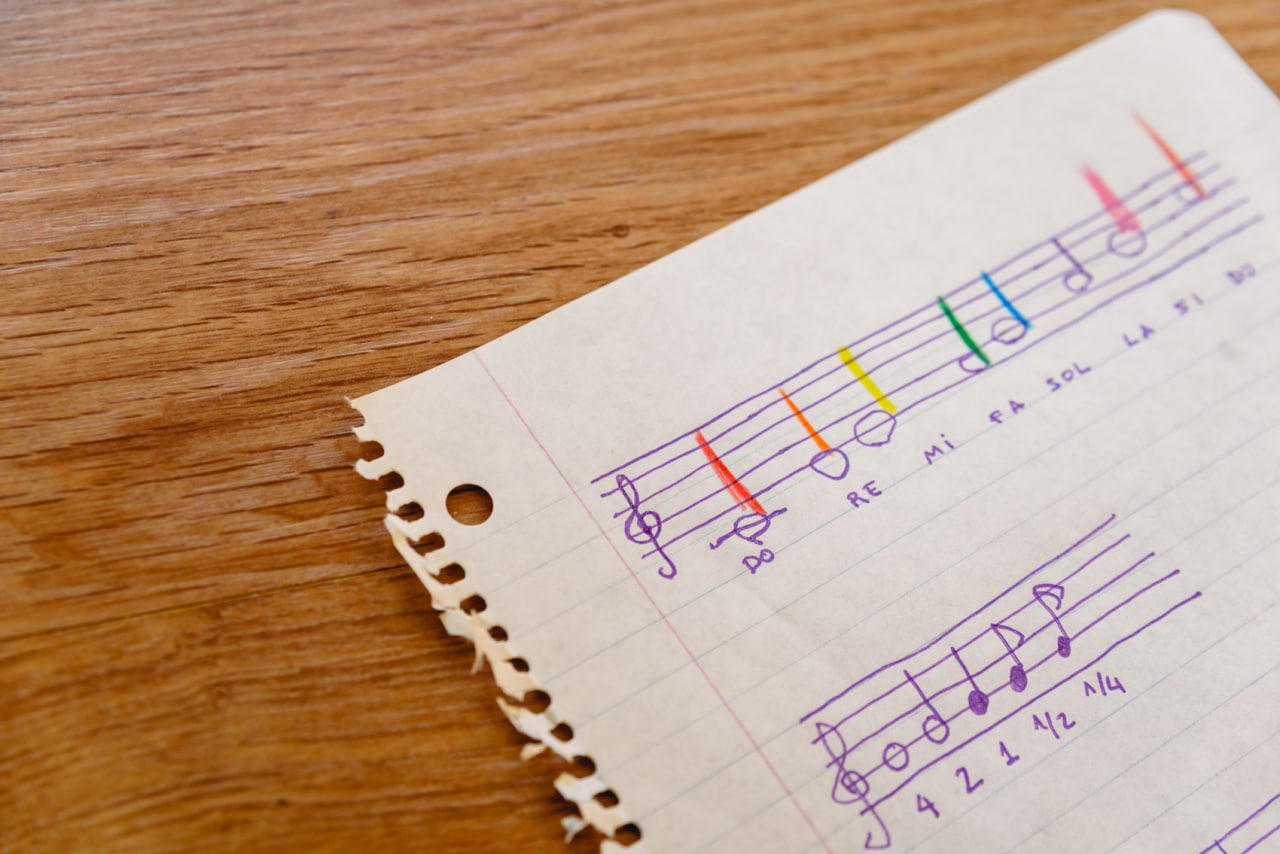
Subdivision means to divide a beat into smaller notes. You can divide a beat into two eighth notes, three triplets, or four sixteenth notes, etc.
Being able to subdivide properly is the key to good timing. Even if you’re playing something really slow, if you can think of the subdivision it will still come out on time.
Subdivision is useful for developing coordination and for eliminating pauses. It is also useful for ensemble playing because it helps players coordinate their subdivision.
Simple and Compound Meter
Meters may be further classified as either simple or compound.
Simple meter: the pulse is divided into two. Compound meter: the pulse is divided into three. So 6/8 time is compound because each pulse is divided into three.
Simple and compound meters create different impressions as well: a compound meter often feels flowing or lilting while a simple meter feels direct and straightforward. Being able to tell the difference is important, as it guides how you perform rhythmic notation.
Syncopation and Rhythmic Interest
Syncopation: The accenting of typically weak beats or off-beats. This is a common way to add rhythmic energy.
Syncopation occurs when rhythms are accentuated off of strong beats. This gives music a strong rhythmic effect and is used often in jazz, pop, funk and more.
To play syncopation well, you need a good internal sense of rhythm. The musician has to feel the underlying pulse no matter where he places the accents.
The Pace and the Emotional Effect
Tempo refers to the rate of speed (fast or slow) at which a piece is played. If rhythm is the pattern of time, then tempo is the speed of that time.
What is tempo conveying? A slower tempo might convey contemplation, warmth, solemnity. A faster tempo may convey energy, panic, happiness. The same rhythm played in a different tempo might convey something entirely different.
To further develop tempo, exercise with a metronome and build up your speed as long as you’re still playing clearly and accurately.