

Melodies, harmonies, and solos revolve around scales and modes. This determines the basic harmonic or key center of a song, and thus dictates the sound of a song, the way a song progresses, and what a song feels like. Scales and modes are the color that chords create. Having mastery over this is having mastery over moods, textures, and tonality.
Regardless if you’re writing, improvising or even just reading music, an understanding of scales and modes gives you the power to transcend playing notes, and instead create music.
What is a scale?
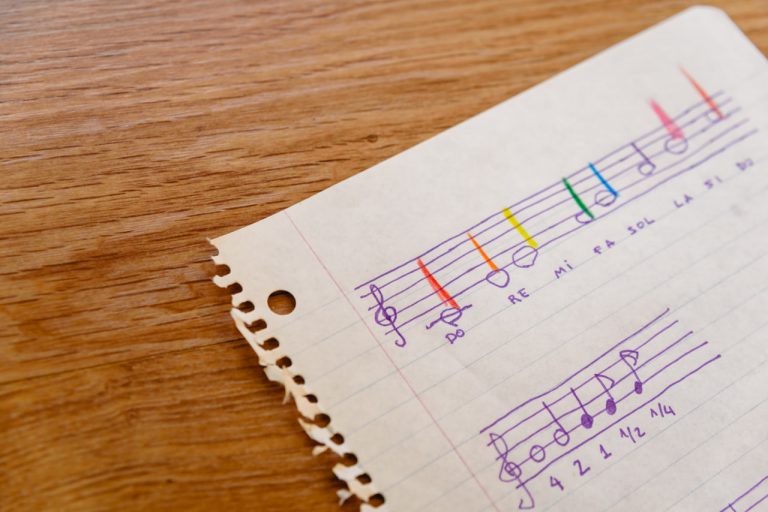
A scale is a series of notes played in a step-by-step pattern, arranged in a specific order of whole and half steps. Different combinations of whole and half steps result in different types of scales.
The major scale is the scale most often used in western music, and its series of whole and half-steps results in a warm, stable-sounding key. And from that single series of whole and half-steps, the entire key system can be derived.
What do scales do? Scales give us melodies, scales give us chords, and scales give us keys. When we understand scales, we understand the underlying structure of tonal music.
The Major Scale: The Foundation of Tonality
The major scale is one of the most popular scales used in music, and it’s probably the first scale most musicians learned how to play. That’s because the major scale’s pattern of whole and half steps sounds harmonious, happy, and final.
The major scale is used to establish the key, or tonal center, of music. The first note of the scale is used as the tonal center (or tonic), which gives music its sense of harmonic “home” for the melodies and chords.
This is why the major scale is such an important concept to master. Knowing the major scale inside and out will help you learn other scales and modes. Most other scales are taken directly from it.
The Natural Minor Scale: A Different Emotional Landscape
This is in contrast to the major scale, which sounds happy and secure. The natural minor scale has a more sombre, contemplative feel to it.
That would be mainly because of the third, sixth and seventh which are minor compared to the major scale. These intervals give the music a different feeling, which is often associated with sadness, mysteriousness, or tension.
That’s not to say that all minor keys sound sad. With different tempo, rhythm, and harmony, they can also sound dramatic, forceful, or aggressive. Everything depends on context.
Variants of the Harmonic and Melodic Minors
Eventually, modifications of the natural minor scale were created to enhance harmonic progressions in minor keys.
The 7th scale degree of the harmonic minor scale is major, giving the leading tone the sense of needing to resolve to the tonic and adding a particular dramatic flair, commonly heard in classical and dramatic music.
The melodic minor scale uses a major 6th and 7th scale degree when going up, but returns to the natural minor when going down. This combination facilitates melody, yet retains the harmonic function of the natural minor scale.
Knowing these differences can increase the composers range of expression within the minor mode.
In simple terms, modes are scales or melodic patterns derived from the major scale. There are seven modes, each named after an ancient Greek mode: Ionian, Dorian, Phrygian, Lydian, Mixolydian, Aeolian, and Locrian. The difference between a mode and a scale lies in the way the notes are used. A scale is a sequence of notes played in order, whereas a mode is more about the musical framework that provides a sense of tonality and chord progression.
A mode is a scale with a given tonal center and pattern of whole and half steps. In Western music, there are seven modes, all of which can be considered derived from the major scale.
Modes have their own intervallic shapes, so they have their own tonal personalities. The intervals may be the same as those in the major scale, but when you change the center of gravity, the notes have a different meaning.
Modes offer a different flavour or feel to the major and minor and can be used to evoke different moods.
The seven modes of the major scale
Ionian is the major scale. It is stable, light and resolute.
The Dorian mode has a raised sixth. It tends to sound slick, soulful, or a bit optimistic in the midst of being a minor mode.
The second degree is lowered in Phrygian, giving it a tense, exotic sound.
The raised fourth in Lydian creates a sense of weightlessness, a kind of ethereal feel that has the effect of making things seem spacious.
The Mixolydian mode is the major scale with the seventh scale degree lowered. It has a very laid back, bluesy feel to it.
Aeolian—the natural minor scale—is for contemplation and reflection.
The Locrian scale features a flatted 2nd and 5th scale degree, which provides a sense of dissonance. It is the least used of the modes, but gives a certain amount of tension.
Understanding the intervals of each mode, composers are able to use the color of their choice when creating.